
Set player level & price
Decide your target players—entry, recreational or advanced—and your preferred retail price range.

Cold-press or thermoformed?
This page compares processes and material selection methods to help you understand their differences and choose the right option for your needs.
Currently two primary constructions: cold‑press and thermoformed. Choose the production process, then define face and core materials.

| Item | Cold Press | Thermoformed One-Piece |
|---|---|---|
| Durability | ||
| Sweet Spot | Medium | Largest |
| Power | Medium | High |
| Control | Medium | Medium–High |
| Unit Cost | Lower | Higher |
| Best For | Entry-level / Test batches | Flagship / Pro series |
First choose construction, then face material, then core and thickness, and finally your product line mix.
Decide your target players—entry, recreational or advanced—and your preferred retail price range.
Based on Step 1, choose cold-press for value and volume, or thermoformed construction for premium and pro models.
Pick fiberglass, T300, T700 carbon, 3K, 12K, 18K, Kevlar or titanium to match your product positioning.
Select PP honeycomb in 10, 13, 14 or 16 mm, or choose Gen3-Gen5, EVA or EPP hybrid cores to balance power and control.
Combine constructions and materials into entry, mid-range and premium models for a clear, balanced product lineup.
Send us your target players, budget and market. We will recommend the best construction, materials and MOQ for your product.
Based on the 6-step framework above, here are three proven paddle line combinations to help new brands launch faster and more effectively.
In terms of durability, if we use the same grade of carbon fiber and PP honeycomb, both constructions last a long time under normal use, though thermoformed paddles tend to have slightly stronger and better shape stability. You can think of cold-press as “easy to play and relaxed” and thermoformed as “more professional and powerful,” each serving a different role in your product line.
Fiberglass more forgiving, while T300/T700 carbon fiber is crisper with better control; 3K/12K/18K woven carbon has a more premium look. Kevlar feels solid and resilient, and Titanium feels faster and more explosive, often used in thermoformed flagship paddles.
If your budget is tight and you’re testing the market, we recommend starting with cold-press paddles because tooling and unit cost are lower and inventory risk is smaller. Once sales are stable, you can add thermoformed premium models to upgrade your brand.
Most new brands do well with 3–4 models for the first launch, for example 2–3 cold-press entry paddles plus 1–2 thermoformed premium paddles and one hero material like Kevlar or Titanium. This covers key price points without spreading your budget too thin.
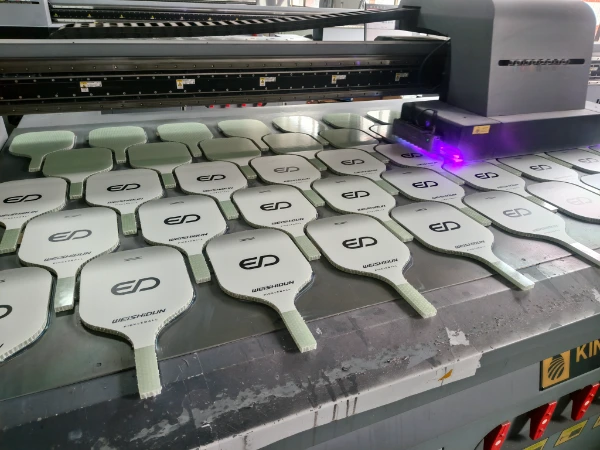
Cold press paddles are made by layering and pressing carbon fiber sheets together without heat, making them a cost-effective option with good performance. Thermoformed paddles, on the other hand, are molded in one piece using high heat, offering superior durability, control, and performance.